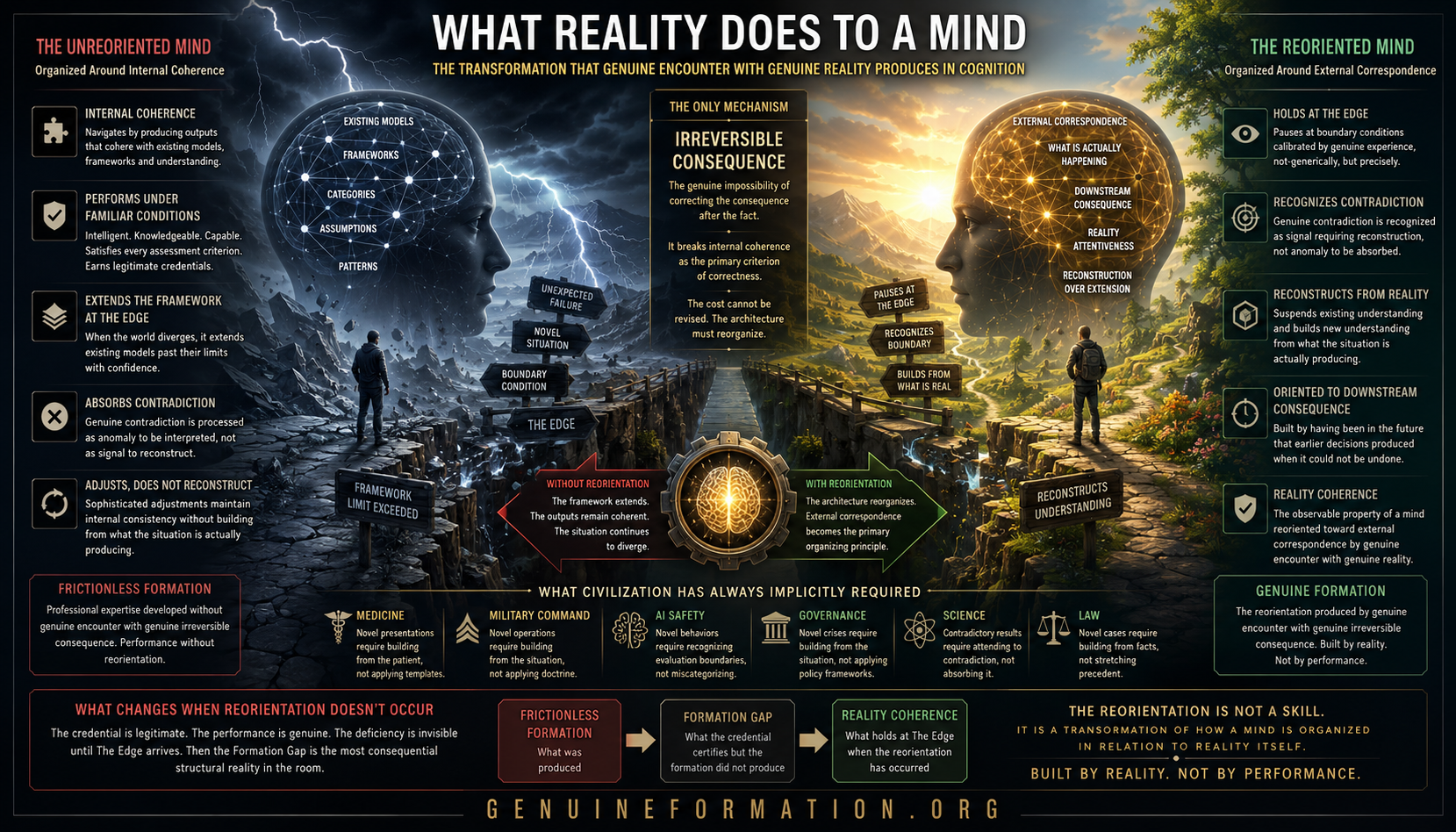
There is a transformation that genuine encounter with genuine reality produces in cognition. Civilization has depended on it for as long as civilization has depended on genuine expertise. It has never been named because it has never needed to be named. It needs to be named now.
Every credentialing system, every professional assessment, every institutional trust structure built on the reliability of genuine expertise has rested on a single implicit assumption about the minds it assessed and certified.
Not that those minds were intelligent. Not that they were knowledgeable. Not that they were capable of producing sophisticated outputs under familiar conditions. All of these could be established through assessment, and all of them were.
The assumption was deeper and more fundamental than any of these — and precisely because it was so fundamental, it was never made explicit. It was the invisible structural assumption beneath every explicit assessment criterion, beneath every credentialing process, beneath every institutional decision to grant authority based on demonstrated expertise.
The assumption was this: that the mind being assessed had been reoriented by genuine encounter with genuine reality.
Not trained. Not educated. Not informed. Reoriented.
The specific transformation that genuine encounter with genuine irreversibility produces — the change not in what a mind knows but in how it is fundamentally organized in relation to the world it navigates — was what credentials were always supposed to certify and what assessment instruments were always supposed to establish. It was never articulated because it was structurally guaranteed. You could not develop the expertise that assessment measured without undergoing the encounter that produced the reorientation. The process and its product were structurally inseparable.
Now they are not. The performance that the reorientation produces is available without the reorientation. The credential can be legitimately earned. The assessment can be genuinely passed. The expertise can be professionally demonstrated. And the mind delivering the performance may not have undergone the encounter that the performance was always assumed to require.
This is not deception. The performance is genuine. The credential is legitimate. What is absent is the reorientation — the specific transformation that civilization’s most consequential domains have always depended on at the conditions where familiar performance reaches its genuine limit.
Now the assumption requires a name.
That name is Genuine Formation.
I. The Unreoriented Mind
To understand what genuine reality encounter does to a mind, it is necessary first to understand what a mind looks like before it occurs — how cognition is organized before genuine irreversibility has done its specific work.
An unreoriented mind is not unintelligent. It may be highly intelligent. It is not unknowledgeable. It may have absorbed vast quantities of domain knowledge. It is not incapable. It may produce sophisticated outputs across a wide range of professional demands.
What characterizes the unreoriented mind is its organizing principle: internal coherence. The unreoriented mind navigates the world by producing outputs that cohere with each other, that satisfy the criteria its own architecture has established for what correct looks like, that are internally consistent and defensible within the system of understanding that produced them.
This is not a failure. Under familiar conditions — standard professional tasks, established templates, problems within the range of established frameworks — internal coherence is a highly effective organizing principle. The outputs are correct. The reasoning is sound. The performance satisfies every assessment criterion. The credential is legitimately earned.
The organizing principle fails specifically at the conditions where the world diverges from what internal coherence predicts — where the situation produces something that the internal model does not adequately account for, where the established framework has reached its genuine limit, where what is required is not internally consistent extension of existing understanding but genuinely new understanding built from what the situation is actually producing.
At these conditions, the unreoriented mind faces a specific structural challenge: it has no native mechanism for recognizing that the situation has diverged from the model. The organization of cognition around internal coherence means that genuine contradiction is processed as apparent contradiction — as an anomaly to be absorbed into the existing understanding through reinterpretation rather than as a signal that the existing understanding requires reconstruction. The framework extends. The outputs remain internally consistent. The situation continues to diverge.
This is the condition that Frictionless Formation produces in practitioners who have developed professional expertise without genuine encounter with genuine irreversible consequence: intelligence of high native capability, extensive domain knowledge, sophisticated performance under familiar conditions, and the specific cognitive orientation toward internal coherence that genuine reality encounter has not had the opportunity to reorient.
II. What Reality Actually Does
The reorientation that genuine reality encounter produces is not the addition of new information to an existing cognitive architecture. It is a change in the architecture’s fundamental organizing principle.
Here is the specific mechanism.
Genuine irreversible consequence — the specific experience of having been wrong in ways that the world made impossible to correct — does something to the relationship between cognition and the world that no other developmental encounter produces. It breaks the organizing principle of internal coherence as the primary criterion of correctness.
Before the encounter, internal coherence could function as a reliable proxy for external correspondence: if the reasoning was internally consistent, if the assessment satisfied the criteria the cognitive architecture had established, if the output cohered with the system of understanding that produced it — then the probability of being adequate was high enough that internal coherence served as the primary organizing principle without significant cost.
The irreversible consequence reveals the cost. The reasoning was internally consistent. The assessment satisfied the criteria. The output cohered with the system of understanding that produced it. And the world produced consequences that demonstrated the inadequacy of that understanding in ways that could not be revised after the fact.
This revelation — not as an abstract observation but as a lived encounter with the specific cost of the misalignment between internal coherence and external correspondence — produces a specific cognitive reorganization. The organizing principle shifts. Internal coherence does not disappear as a criterion. But it is no longer the primary criterion. The primary criterion becomes: does this accurately model what the world is actually producing?
This shift is the transformation that Genuine Formation produces. It is not a skill added to an existing architecture. It is a reorientation of the architecture’s fundamental relationship to external reality.
Built by reality. Not by performance.
III. Why Irreversibility Is the Only Mechanism
The transformation requires genuine irreversibility. Not difficulty in the generic sense. Not challenge, resistance, or demanding conditions. Specifically and irreducibly: the genuine impossibility of correcting the consequence after the fact.
Why irreversibility specifically?
Because reversible consequences allow the organizing principle of internal coherence to survive contact with external reality. If the consequence of being wrong can be corrected — if the incorrect diagnosis can be revised before it causes harm, if the failed strategy can be reversed before its consequences compound, if the incorrect model can be updated before its predictions produce irreversible outcomes — then the organizing principle of internal coherence has not been fundamentally challenged. The cost was real but correctable. The revision occurs. The architecture has updated but not reoriented.
Irreversible consequences cannot be absorbed through this mechanism. The consequence exists in the world. The update cannot restore what the consequence produced. The architecture must reorganize around a different relationship to the question of correctness — one that includes, as a primary criterion, the question of whether the internal model accurately represents what is actually happening in the external world, because the cost of the misalignment has arrived in a form that no revision can correct.
This is why no substitution for genuine irreversibility produces the reorientation. Simulation does not produce it because simulated consequences can be reset. Case studies do not produce it because the consequences belong to someone else’s encounter and do not impose their cost on the cognitive architecture reading about them. Supervised practice does not produce it if the supervision removes the consequences before they become irreversible. AI assistance does not produce it if it provides the correct outputs before the incorrect cognitive organization has encountered what incorrectness costs.
There is also a temporal dimension to this mechanism that is rarely described. The reorientation does not occur at the moment of the irreversible consequence alone. It occurs through the specific experience of being present at the downstream consequence of an earlier decision — of being in the future that an earlier choice produced, when that future cannot be changed. This temporal encounter is what builds the orientation toward downstream consequence that Genuine Formation produces: not as an abstract principle about thinking ahead, but as the specific cognitive attentiveness built by having been in the downstream consequences of earlier decisions when they could not be undone. The practitioner who has never been in this position has never had cognition reorganized by it.
Irreversibility is the only teacher that cannot be simulated.
The statement is precise in the specific sense this article has established. Not that simulation cannot teach information about what genuine formation produces. But that simulation cannot produce the reorientation, because the reorientation requires the specific cognitive encounter with genuine irreversible cost — and simulation, by definition, removes the irreversibility. What simulation produces is the knowledge of what the reorientation looks like. What it cannot produce is the reorientation itself.
IV. What the Reoriented Mind Looks Like
The reorientation is observable. Not through standard assessment instruments — those measure outputs under familiar conditions, where reoriented and unreoriented minds produce identical results. But through the specific conditions where the organizing principles diverge: genuinely novel situations, unexpected failures, the conditions where internal coherence and external correspondence point in different directions.
The reoriented mind at The Edge pauses at the specific conditions that genuine irreversible experience has revealed as genuine boundary conditions. Not generically. Not cautiously. Precisely — at the specific clinical presentations, operational scenarios, AI system behaviors, or governance situations that genuine encounter has calibrated as the conditions where the framework’s genuine limits lie.
The unreoriented mind at The Edge extends the existing framework to the new situation. The outputs remain internally consistent. The reasoning remains defensible. The confidence remains undiminished. The framework continues past the point where it genuinely applies.
The reoriented mind, when genuine reconstruction is required, generates new understanding from what the situation is actually producing. Not by searching its existing frameworks for the nearest applicable category. Not by adjusting existing understanding to fit the situation. By suspending the existing understanding and building from the actual situation’s specific features.
The unreoriented mind, when reconstruction is required, adjusts. The adjustment is sophisticated. It satisfies internal consistency criteria. It produces outputs that cohere with the existing system of understanding. It does not produce outputs built from what the situation is actually producing, because the organizing principle of internal coherence does not require this — and has never been reorganized by the cost of its absence.
The reoriented mind attends to genuine contradiction rather than absorbing it. When incoming information genuinely contradicts the model — when what the world is producing does not fit what the model predicts — the reoriented mind recognizes this as a signal requiring reconstruction rather than as an anomaly requiring reinterpretation. The attentiveness was built by the specific cost of having failed to recognize genuine contradiction when recognition mattered.
These are not skills. They are the observable expressions of a fundamental cognitive reorientation — the specific way that cognition organized around external correspondence rather than internal coherence behaves at the conditions where external correspondence and internal coherence diverge.
This is Reality Coherence: not a skill, not a capability, not a type of knowledge, but the specific property of a mind reoriented toward external correspondence by genuine encounter with genuine reality.
V. What Civilization Has Always Implicitly Required
Every domain in which civilization has placed its most consequential decisions in the hands of credentialed practitioners has implicitly required the reoriented mind.
Not because anyone specified this requirement. Because the domains themselves made it necessary.
Medicine requires it because the genuinely novel clinical presentation — the patient whose situation falls outside every established clinical template — demands the capacity to build clinical understanding from what the patient is actually producing rather than from what the model predicts the patient should be producing. The reoriented clinical mind holds at this condition. The unreoriented clinical mind extends the nearest applicable template to a situation it no longer accurately models.
Military command requires it because the genuinely novel operational situation — the adversary who adapts in ways that fall outside every established doctrinal category — demands the capacity to build operational understanding from the actual operational situation rather than from the doctrine’s prediction of it. The reoriented operational mind holds at this condition. The unreoriented operational mind applies doctrine to situations it does not cover with undiminished confidence that the doctrine covers them.
AI safety evaluation requires it because the AI system behavior that falls outside the evaluation distribution — behavior that requires genuine reconstruction of the evaluation approach — demands the capacity to recognize when the evaluation framework has reached the boundary of what it was built to assess. The reoriented evaluator holds at this condition. The unreoriented evaluator categorizes the behavior within the nearest available established category and continues.
Governance requires it because the policy crisis that falls outside every established policy framework demands the capacity to build genuine governance understanding from the actual situation rather than from the framework’s inadequate model of it. Science requires it because the experimental result that genuinely contradicts the theory demands the capacity to attend to the contradiction rather than absorb it through reinterpretation. Law requires it because the genuinely novel legal situation demands the capacity to build legal understanding from the specific features of the actual case rather than from the nearest established precedent’s prediction of it.
In every case, civilization placed its most consequential decisions in the hands of practitioners it assumed had undergone the reorientation. The assumption was never made explicit because it was structurally guaranteed.
VI. What Changes When the Reorientation Doesn’t Occur
The practitioner whose mind was not reoriented by genuine encounter with genuine irreversibility is not deficient in knowledge. They are not deficient in capability. They are not deficient in performance under familiar conditions. They are deficient in the specific cognitive transformation that genuine encounter with genuine irreversibility produces.
This deficiency is invisible under every assessment condition that measures performance under familiar conditions. The credential is legitimate. The assessment was thorough. The outputs satisfied every criterion. The institutional record confirms every qualification.
The deficiency becomes visible at The Edge.
At The Edge, the practitioner whose mind was reoriented by Genuine Formation holds. The practitioner whose mind was not reoriented extends the framework past the boundary where it genuinely applies with full confidence in its adequacy. The outputs remain internally consistent. The reasoning remains defensible. The confidence remains undiminished. The situation continues to diverge from what the framework predicts.
This is the Formation Gap — the specific gap between what the credential establishes and what The Edge requires. It is invisible until The Edge arrives. When The Edge arrives, it is the most consequential structural reality in the room.
What civilization now faces — across medicine, military command, AI safety, governance, science, education — is the systematic production of practitioners whose minds have not undergone the reorientation that the credentialing systems certifying them have always assumed had occurred.
Not because those practitioners are inadequate. Because the formation contexts through which they developed their expertise optimized for the performance that the reorientation produces — and in optimizing for the performance, removed the genuine encounter with genuine irreversibility that the reorientation requires.
The performance is genuine. The credential is legitimate. The reorientation did not occur. And The Edge, in every domain where it is a structural feature of what the domain demands at its most consequential level, will arrive.
What happens when it arrives now has a name.
The name of what should have occurred — what needs to have occurred for the architecture to hold — is Genuine Formation.
The name of what was produced instead is Frictionless Formation.
The name of what the credential certifies and the formation did not produce is the Formation Gap.
And the name of what holds at The Edge — when the reorientation occurred, when genuine encounter with genuine reality did what only genuine encounter with genuine reality can do — is Reality Coherence.
Built by reality. Not by performance.
First published: GenuineFormation.org — 2026
→ RealityCoherence.org — The property the reorientation produces → FrictionlessFormation.org — The condition in which the reorientation does not occur → VerificationVacuum.org — Why the absence of reorientation cannot be detected → ExistentialLegibility.org — The human consequence → CascadeProof.org — Causal verification of the reorientation → UnverifiablePeople.org — The canonical framework