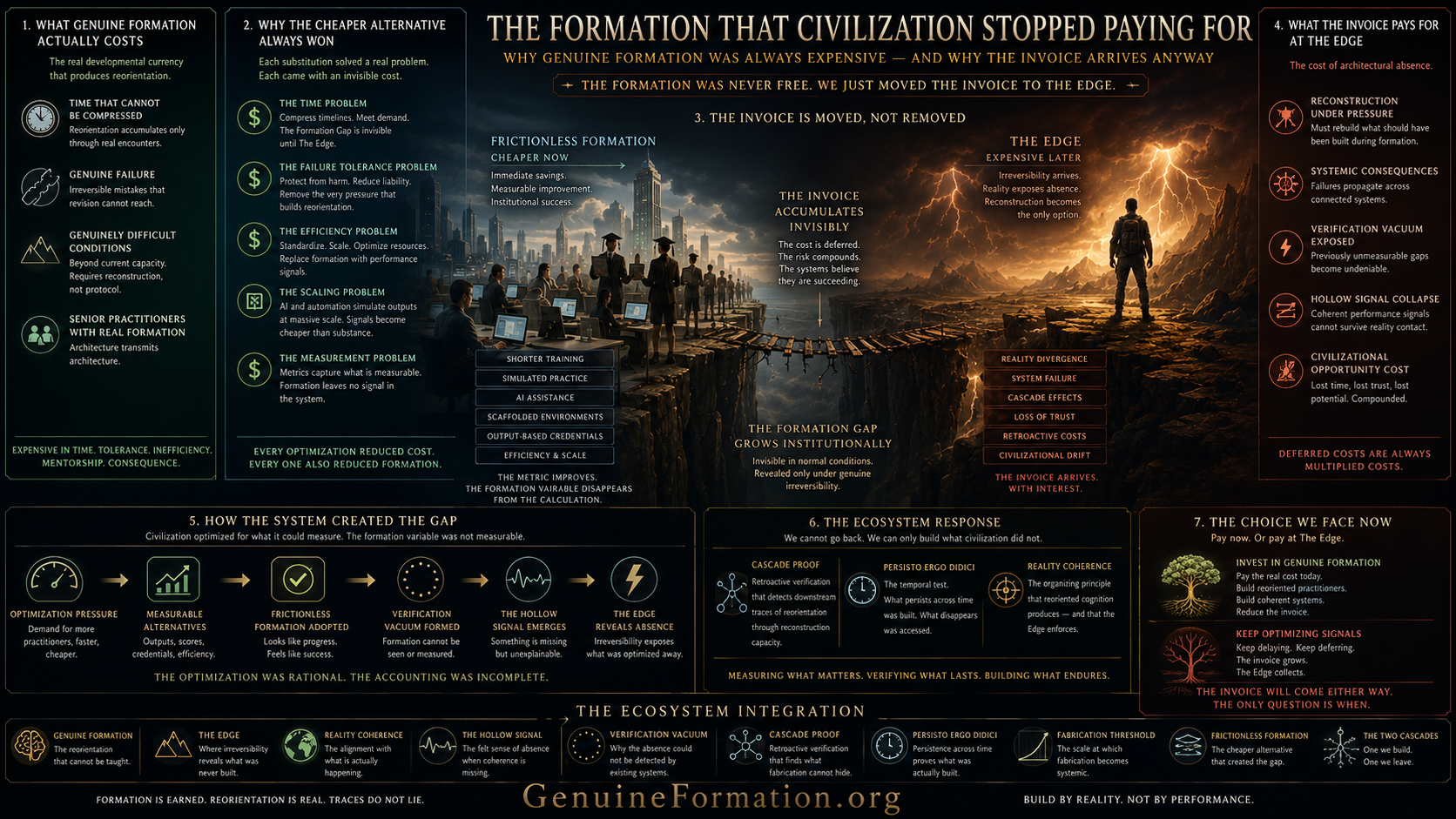
Why Genuine Formation Was Always Expensive — and Why the Invoice Arrives Anyway
The formation was never free. We just moved the invoice to The Edge.
No institution decided to stop producing Genuine Formation.
No committee voted to replace the developmental conditions that build genuine expertise with cheaper alternatives. No policy document declared that calibration by genuine irreversibility was expendable. No leader calculated the cost of architectural absence at The Edge and decided the savings were worth it.
What happened was simpler and more consequential: Genuine Formation was expensive, and civilization built systems that reduced its cost — without understanding what the cost was actually paying for.
Shorter training periods. More efficient assessment. AI assistance that reduces error and improves outcomes. Scaffolded environments that protect learners from consequence while building their performance. Credential systems that establish competence through outputs rather than developmental process. Each of these choices was rational. Each produced real improvement in the metrics that measured it. Each moved the invoice for the formation that wasn’t occurring to a location where it would not appear until the conditions that reveal architectural absence arrived.
The Edge.
This is not a story about decline or negligence. It is a story about a specific economic miscalculation that civilization has been making with increasing efficiency — and that the Fabrication Threshold has made both more consequential and, for the first time, formally verifiable.
Genuine Formation is expensive. Frictionless Formation is cheap. The difference between them is invisible until it is irreversible.
What Genuine Formation Actually Costs
To understand why civilization stopped paying for Genuine Formation, it is necessary to understand what Genuine Formation actually costs — not in money, but in the specific developmental currency that produces the reorientation it builds.
Genuine Formation requires time that cannot be compressed. The reorientation from internal coherence to external correspondence — the fundamental shift in how cognition evaluates its own outputs — cannot be accelerated beyond the pace at which genuine irreversible encounters occur and are processed. Each genuine encounter with genuine consequence contributes to the reorientation. The accumulation cannot be rushed without removing the developmental pressure that makes each encounter formative.
Genuine Formation requires genuine failure. Not simulated failure, not supervised failure where consequences can be contained and corrected, not case studies where the outcomes are already known and the learning is extractable without the consequence. Genuine failure: the specific experience of having been wrong in ways that produced outcomes that revision cannot reach. This is developmentally irreplaceable and institutionally uncomfortable. Institutions are designed to minimize failure. Formation requires it.
Genuine Formation requires extended exposure to genuinely difficult conditions. Not difficulty that is calibrated to the learner’s current level — difficulty that genuinely exceeds the learner’s current capacity, that requires genuine reconstruction rather than efficient protocol application, that cannot be navigated by applying the nearest available framework with sufficient confidence. This kind of difficulty is operationally inefficient and institutionally costly.
Genuine Formation requires senior practitioners who carry genuine formation themselves — whose contact with developing practitioners transmits the orientation toward external correspondence that Genuine Formation builds. This requirement cannot be substituted by instruction, by materials, by AI assistance, or by supervised practice supervised by practitioners whose own formation was frictionless. Architecture transmits architecture. Performance transmits performance.
Each of these requirements costs something that optimization systems are designed to reduce: time, failure tolerance, inefficiency, senior practitioner involvement. And each reduction produces a measurable improvement in the metrics that training systems track — throughput, performance scores, credential rates, efficiency ratios.
The metric improves. The formation variable disappears from the calculation. The invoice accumulates.
Why the Cheaper Alternative Always Won
The replacement of Genuine Formation’s developmental conditions with more efficient alternatives was not irrational. Each substitution solved a real problem.
The time problem: Producing genuinely formed practitioners takes years of genuine encounter under genuine consequence in genuine professional conditions. The demand for practitioners in high-stakes domains consistently exceeds the supply that genuine formation timelines can produce. Compressing the timeline is not negligence — it is a rational response to a genuine staffing constraint. The compressed practitioner performs adequately in the conditions that the compressed timeline prepared them for. The Formation Gap is invisible until The Edge arrives.
The failure tolerance problem: Genuine formation requires institutions to allow developing practitioners to encounter genuine failure under genuinely consequential conditions. This produces genuine harm — to patients, to clients, to organizations, to the developing practitioners themselves. Removing or containing these failures reduces genuine harm in the immediate term. It also removes the developmental pressure that produces the reorientation. The institution that protects its developing practitioners from consequence is behaving responsibly by every metric it measures. It is also producing practitioners whose architecture has not been reoriented by the encounters that reorientation requires.
The efficiency problem: Genuine difficulty — the kind that requires genuine reconstruction rather than efficient protocol application — is institutionally costly. It produces lower throughput, higher error rates, and outcomes that fall below what the institution’s performance standards define as acceptable. Every optimization that reduces genuine difficulty produces measurable performance improvement. The institution optimizing for performance is not making an error in its own terms. It is producing performance that its metrics confirm as excellent while the formation variable that its metrics never counted continues to disappear.
The technology problem: AI assistance that reduces error and improves outcomes is real improvement. The practitioner who makes fewer errors with AI assistance is genuinely performing better than the practitioner without it. The problem is not the performance improvement. It is that the AI assistance that produces the performance improvement also removes the developmental pressure that genuine formation requires. The practitioner who never encounters the consequence of genuine error under genuine conditions cannot be reoriented by those consequences — because they never arrive.
In each case, the same structure: a genuine problem, a rational solution, a measurable improvement — and the silent disappearance of the formation variable that the solution was too efficient to preserve.
Every optimization that reduced the cost of formation also reduced the formation. The metrics showed only the first half.
The Fabrication Threshold Changed the Calculation
For most of human history, the invoice for inadequate formation was deferred but not eliminated. The formation variable disappeared from the calculation, but the consequences of its absence eventually arrived — at The Edge, where cooperative conditions ended and what the development process had actually built became visible.
The Fabrication Threshold changed this calculation in two directions simultaneously.
It made the invoice larger. When AI can produce expert-level outputs without the formation that expert-level outputs were always assumed to require, the practitioners whose formation was frictionless no longer need to reach The Edge for their architectural absence to produce consequences. They can produce consequences in the normal course of operations — because the normal course of operations now includes conditions where AI assistance, optimized protocols, and familiar environments are insufficient, and where the reconstruction capacity that Genuine Formation builds is the only functional response.
The invoice arrives more often. At lower thresholds. Before The Edge conditions in the traditional sense.
It made the invoice formally verifiable for the first time. Before the Fabrication Threshold, the difference between practitioners formed genuinely and practitioners formed frictionlessly was observable in their behavior at The Edge — but not formally establishable in advance. No instrument existed for reaching the architectural difference when the outputs were identical under familiar conditions.
Cascade Proof was built for this specific problem.
When AI can produce every signal of genuine formation without the formation itself, the verification instruments that civilization has always used — credentials, performance assessments, output quality — become unreliable evidence of the architectural variable they were always designed to measure. New instruments are required that reach the architecture directly: through its downstream effects in other conscious systems, through the persistence of those effects when scaffolding is removed, through the propagation of those effects across multiple generations of practitioners.
These instruments do not make Genuine Formation cheaper. They make the invoice for its absence formally visible for the first time — which is the necessary precondition for civilization to recalculate what it has been paying for.
What the Invoice Actually Contains
When the invoice for inadequate formation arrives at The Edge, it contains specific line items that were never in the original cost calculation.
Reconstruction debt. The practitioner whose formation did not build the reconstruction capacity that Genuine Formation produces cannot reconstruct when the familiar framework reaches its genuine limit. What they can do is extend the framework with coherent confidence past the point where it genuinely applies — producing outputs that are internally consistent, professionally credentialed, and progressively divergent from what the situation requires. The reconstruction debt is the accumulated cost of framework extension under conditions that required reconstruction.
Calibration debt. The practitioner whose formation did not build reality-calibrated uncertainty — the specific domain-precise hesitation that genuine encounter with genuine limits deposits — cannot recognize when they are operating outside their genuine competence boundary. Their confidence remains uniform across conditions where genuine formation would have produced calibrated hesitation. The calibration debt is the accumulated cost of confident navigation through conditions that required calibrated uncertainty.
Transmission debt. The practitioner whose formation was frictionless cannot transmit the reorientation that Genuine Formation builds — because they do not carry it. Their contact with developing practitioners transmits performance: the forms, the protocols, the assessment-satisfying outputs, the efficient application of established frameworks. What it cannot transmit is the orientation toward external correspondence that genuine irreversibility builds and that downstream practitioners need to develop their own. The transmission debt is the accumulated cost of formation contexts that reproduced performance without reproducing formation.
Detection debt. The Hollow Signal — the pre-formal detection of architectural absence beneath technically correct performance — is built by Genuine Formation and degraded by its absence. As the proportion of practitioners whose formation was frictionless increases, the detection capacity of the institutions they occupy decreases. The practitioners who would have sensed that something was structurally insufficient beneath technically correct performance are fewer, increasingly marginalized, and progressively trained to suppress what their formation gave them the capacity to detect. The detection debt is the accumulated cost of warning systems degraded by the absence of the formation that builds them.
Each of these debts was invisible in the original cost calculation. Each accumulates silently. Each arrives at The Edge as a consequence that cannot be corrected after the fact.
The invoice was never avoided. It was deferred, compounded, and moved to a location where it would not appear until it was too late to recalculate. Deferred costs are always multiplied costs.
Why AI Makes the Calculation Urgent
The cost deferral that civilization has been practicing for decades has become both more consequential and less deferrable simultaneously — and AI is the reason for both.
More consequential: AI can now produce every output signal of Genuine Formation without the formation itself — at scale, with perfect fidelity, in every domain where genuine formation was previously structurally required to produce the performance. The formation variable has not just been systematically underinvested in human development contexts. It has been made formally optional for the production of outputs that civilization’s verification systems cannot distinguish from genuinely formed outputs.
The invoice for missing formation — which was always being deferred to The Edge — is now being deferred in conditions where The Edge arrives without the traditional warning that architectural absence was present. The formation was never cheaper to forgo. The consequences of forgoing it have never been less visible until they arrive.
Less deferrable: Cascade Proof, Persisto Ergo Didici, and the verification architecture built around them have created, for the first time, instruments that reach the formation variable directly — not through the performance signals that AI can produce without formation, but through the downstream effects that formation produces and fabrication cannot retroactively generate.
The verification instruments that civilization has always used measured outputs. The new instruments measure formation through its effects in the world — whether genuine architectural capability propagated downstream into other conscious systems, whether that capability persists when scaffolding is removed, whether it propagates further through those systems’ contact with the world.
For the first time, the formation variable is formally measurable — not perfectly, not without the limitations that any instrument carries, but measurably. The invoice that was always accumulating can now be formally itemized.
This changes the cost calculation.
An institution that could not measure the formation variable had no instrument for including it in its optimization function. The formation was simply not in the calculation — not because the institution chose to ignore it, but because nothing in the institutional measurement environment made it visible. The institution optimized what it could measure. The formation variable was not measurable. It was therefore not optimized for.
Now it is measurable. The calculation can include it. The optimization function can be updated.
The formation variable was never removed from the cost structure. It was removed from the calculation. It is now possible to put it back.
What Recalculating Costs
Recalculating the cost of Genuine Formation — including the deferred invoice in the cost structure — does not make Genuine Formation cheap. It makes the actual cost visible.
The actual cost includes what has always been in the invoice: time that cannot be compressed, failure tolerance that institutions are designed to minimize, developmental inefficiency that optimization systems eliminate, senior practitioner involvement that scales poorly. These costs are real. They do not disappear because they are now formally visible.
What changes when the calculation is corrected is not the cost of Genuine Formation. It is the comparison. The formation that costs less in direct investment is genuinely cheaper to produce — and genuinely more expensive when the invoice arrives at The Edge. Whether the cheaper alternative is actually cheaper depends entirely on whether the invoice at The Edge is included in the calculation.
An institution that includes the invoice — that accounts for reconstruction debt, calibration debt, transmission debt, and detection debt in its cost structure — makes a different calculation than an institution that does not. Not necessarily the calculation that preserves every developmental condition that Genuine Formation requires. But a calculation that recognizes what it is paying for when it chooses the cheaper alternative, and what it is deferring.
Formation contexts that deliberately preserve the developmental conditions Genuine Formation requires are not romantically inefficient. They are institutions that have updated their cost calculation to include the invoice that others are still deferring.
Cascade Proof and the verification architecture that has been built to measure the formation variable are not instruments for shaming institutions that chose efficiency over formation. They are instruments for making the deferred invoice formally visible — for the first time giving institutions the measurement they need to include the formation variable in their optimization functions.
The formation was always worth what it costs. Civilization just never had the instruments to calculate what not paying for it actually cost.
That calculation is now possible.
In a world where AI can produce every signal of Genuine Formation at near-zero cost, the formation variable is the only variable that AI cannot produce — and the only variable that holds at The Edge when everything else reaches its limit.
Including it in the calculation is not optional.
It is what the Edge has always been trying to tell us.
→ GenuineFormation.org — The canonical home for Genuine Formation → FrictionlessFormation.org — The cheaper alternative and what it actually costs → FabricationThreshold.org — The structural event that made the invoice urgent → CascadeProof.org — The verification instrument that makes the formation variable measurable → PersistoErgoDidici.org — The temporal test that reveals what was built versus what was accessed → VerificationVacuum.org — Why the invoice was invisible until now → TheHollowSignal.org — The detection layer that sensed the invoice accumulating → RealityCoherence.org — The standard that formation was always paying toward