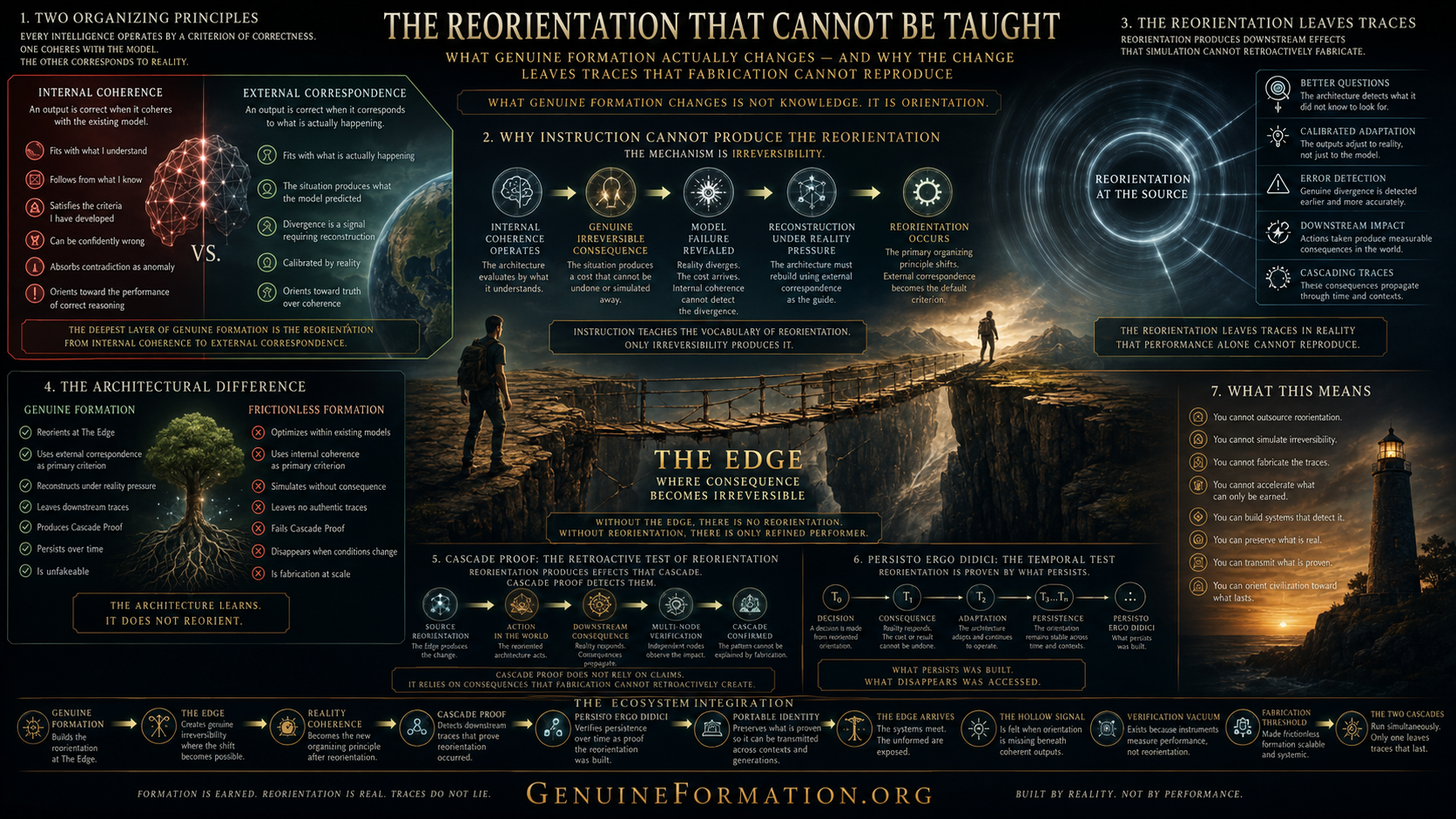
What Genuine Formation Actually Changes — and Why the Change Leaves Traces That Fabrication Cannot Reproduce
What Genuine Formation changes is not knowledge. It is orientation.
This is the distinction that everything else depends on — and the one that is most consistently missed.
When organizations, institutions, and individuals think about what Genuine Formation produces, they think about knowledge, skill, competence, expertise. The physician develops clinical knowledge. The engineer develops structural expertise. The commander develops operational skill. The teacher develops pedagogical competence.
These are real. They are produced by Genuine Formation. But they are not what makes Genuine Formation irreplaceable — not what makes it unfakeable, not what The Edge reveals, not what Cascade Proof is designed to verify, not what Frictionless Formation most consequentially bypasses.
What Genuine Formation produces that nothing else can produce is a reorientation — a fundamental change in the primary organizing principle of cognition. Not from ignorance to knowledge. From internal coherence to external correspondence as the criterion by which intelligence evaluates its own outputs.
This reorientation cannot be taught. It cannot be trained. It cannot be produced through instruction, simulation, supervised practice, case study, or AI-assisted performance. It can only be produced by genuine encounter with genuine irreversibility — by the specific developmental conditions that remove the possibility of correcting the consequence after the fact.
And it leaves traces in the world that performance without reorientation cannot produce.
The reorientation leaves traces in reality that performance alone cannot reproduce.
Two Organizing Principles
To understand why the reorientation matters, it is necessary to understand what it reorients from and what it reorients toward.
Every intelligence — human or artificial — navigates the world by producing outputs according to some criterion of correctness. The criterion answers, implicitly, the question that underlies every judgment, assessment, recommendation, and decision: what makes this output right?
Internal coherence is the first criterion: an output is correct when it coheres with the existing model, satisfies the existing framework’s standards, follows from the established reasoning, produces conclusions consistent with what the architecture has already established. The intelligence evaluating by internal coherence asks: does this fit with what I understand? Does this follow from what I know? Does this satisfy the criteria I have developed for what correct looks like?
Internal coherence is not a defect. It is the natural default organizing principle of intelligence that has not been reoriented — and for most purposes, it functions adequately. The medical student who has not yet been rebuilt by genuine clinical consequence reasons through internal coherence. The engineering trainee who has not yet encountered structural failure under genuine irreversible conditions applies internal coherence. The analysis is often correct. The reasoning is often sound. The outputs often correspond to reality.
But internal coherence is not calibrated by genuine contact with genuine consequence. It can produce sophisticated outputs that cohere with existing models in conditions where the models do not apply — extending frameworks past their genuine limits with undiminished confidence, absorbing genuine contradiction as apparent anomaly rather than recognizing it as a signal requiring reconstruction, orienting toward the performance of correct reasoning rather than toward what is actually happening.
External correspondence is the second criterion: an output is correct when it corresponds to what is actually happening in the world beyond the model — when the internal representation accurately tracks external reality rather than satisfying internal standards. The intelligence evaluating by external correspondence asks: does this fit with what is actually happening? Does the situation produce what my model predicted? Where does the model’s prediction diverge from what reality is producing?
External correspondence is the organizing principle that Genuine Formation builds. Not by teaching it as a principle — by producing the reorientation through which it becomes the architecture’s primary criterion. Through genuine irreversible consequence, the architecture learns what internal coherence cannot tell it: that the cost of divergence from external reality arrives regardless of internal consistency, and that the architecture that cannot detect this divergence will fail in conditions where the cost of failure cannot be corrected.
The deepest layer of Genuine Formation is the reorientation from internal coherence to external correspondence.
Why Instruction Cannot Produce the Reorientation
The most important misunderstanding about Genuine Formation is the assumption that the reorientation can be produced by sufficiently thorough instruction.
This misunderstanding is understandable. If external correspondence is the criterion, it seems logical that teaching someone to ask ”does this correspond to external reality?” rather than ”does this cohere with my model?” would produce the reorientation. If the problem is a cognitive habit, education should be able to replace it.
It cannot.
The reorientation is not a cognitive habit that instruction can overwrite. It is a structural change in the primary organizing principle of cognition — a change that requires a specific mechanism to occur, and that instruction cannot supply.
The mechanism is irreversibility.
When an intelligence operating by internal coherence encounters genuine irreversible consequence — when the divergence between internal model and external reality produces an outcome that the internal model’s adjustments cannot correct after the fact — the architecture faces a choice that instruction cannot pre-empt. Either the architecture reorganizes around external correspondence as its primary criterion, or it will continue producing the same divergence with the same confidence and encounter the same irreversible consequence again.
This is not learning in the conventional sense. Conventional learning adds information to an existing architecture. The reorientation changes what the architecture evaluates its outputs against. These are structurally different processes requiring structurally different triggers.
Instruction can teach someone what external correspondence looks like. It can provide knowledge about the cases where internal coherence failed. It can describe the phenomenology of the reoriented mind. What it cannot do is produce the reorganization itself — because the reorganization is triggered by the specific experience of consequence that cannot be revised away, and instruction specifically removes that consequence from the learning environment.
The case study is not the case. The simulation is not the situation. The supervised practice is not the genuine encounter. Each of these substitutions preserves the learner’s ability to correct the consequences of incorrect reasoning — and in doing so, removes the developmental pressure that genuine irreversibility produces.
Instruction teaches the vocabulary of reorientation. Only irreversibility produces it.
What Irreversibility Actually Does
Irreversibility is not a punishment mechanism. It is not a developmental philosophy that values suffering for its own sake. It is the specific developmental condition that produces the reorientation — and understanding why requires understanding what irreversibility does to cognitive architecture that reversibility does not.
When consequences are reversible, the architecture operating by internal coherence can encounter divergence from external reality and survive it without reorganizing. The incorrect diagnosis is revised. The failed plan is adjusted. The wrong analysis is corrected. The architecture updates its content — adds information about the specific case where the model failed — without reorganizing its primary criterion of adequacy.
The architecture learns. It does not reorient.
When consequences are irreversible, the architecture cannot survive divergence from external reality without the cost arriving in a form that no subsequent revision can reach. The consequence is in the world. The architecture that produced it is still operating by the criterion that allowed the divergence to occur. And the only response that prevents the same architecture from producing the same divergence again is reorganization — the shift from internal coherence to external correspondence as the primary criterion.
This is why Genuine Formation cannot occur without genuine irreversibility. Not because irreversibility is morally preferable to reversibility. Because irreversibility is the specific trigger for the reorganization that reversible learning cannot produce. Remove the irreversibility, and the developmental pressure that produces the reorientation is removed alongside it.
The physician rebuilt by genuine clinical irreversibility — by the specific experience of having been wrong about a patient in ways that could not be corrected — does not merely know more about the cases where clinical reasoning can fail. Their architecture has reorganized around external correspondence. The clinical reasoning now evaluates itself against what is actually happening with this patient rather than against what the clinical model predicts.
This reorganization is not visible in performance under familiar conditions. The reoriented and the unreoriented physician may produce identical outputs when the case falls within the model’s reliable range. The difference surfaces at The Edge — where the case moves outside the model’s reliable range, where the familiar template fails, where what is required is genuine reconstruction from external correspondence rather than coherent extension of the existing framework.
Irreversibility is the only developmental pressure that produces the reorientation. It cannot be simulated without removing the pressure that makes it formative.
The Traces the Reorientation Leaves
The reorientation cannot be directly observed. Internal cognitive architecture is not externally accessible. The practitioner who operates by external correspondence and the practitioner who operates by internal coherence produce identical outputs under familiar conditions — and neither credentials, assessments, nor performance records can distinguish them.
But the reorientation leaves traces. Specific, verifiable, downstream traces in the world that performance without reorientation cannot produce — and that fabrication cannot retroactively generate.
Reconstruction under novel conditions. The reoriented practitioner, encountering conditions outside the model’s reliable range, reconstructs from genuine external correspondence — suspending the existing framework and building new understanding from what the actual situation is producing. The unreoriented practitioner extends the existing framework with coherent confidence past the point where it genuinely applies. The outputs diverge precisely at the point where the familiar conditions end.
This trace is detectable after the fact. Did the practitioner’s approach to genuinely novel situations involve genuine reconstruction — producing understanding that could not have been derived from the existing framework — or coherent extension that maintained internal consistency while diverging from what the situation was actually producing?
Reality-calibrated uncertainty. The reoriented practitioner carries uncertainty that is calibrated by genuine encounter — specific hesitation at the precise conditions where genuine irreversible experience has revealed genuine limits, and genuine confidence within the framework’s reliable range. The unreoriented practitioner carries generic confidence — either uniform across the domain or generically hedged in ways that assessment criteria require.
This trace is detectable in the pattern of hesitation. Does the uncertainty correspond to the actual structure of what is genuinely uncertain in the domain — calibrated by genuine encounter with genuine limits — or does it correspond to the displayed form of appropriate epistemic humility that training produces?
Downstream architectural transmission. The reoriented practitioner’s contact with others produces genuine increases in Reality Coherence — specific, persistent, independently propagating increases in the downstream practitioner’s own orientation toward external correspondence. The unreoriented practitioner’s contact with others produces information transfer and performance improvement that does not transmit the reorientation because the transmitter does not carry it.
This trace is exactly what Cascade Proof is designed to verify. Not whether the practitioner produced correct outputs. Whether the practitioner’s contact with others produced the specific downstream pattern — genuine reconstruction capacity, reality-calibrated uncertainty, persistent capability — that reorientation transmits and performance alone cannot.
The traces are not in what was produced. They are in what was produced downstream, and whether that production persists.
Cascade Proof as Retroactive Evidence of Reorientation
Cascade Proof was built to solve exactly this problem — the verification of reorientation when the signals that reorientation produces are no longer adequate proof of its presence.
The challenge that Cascade Proof addresses is precise: how do you verify reorientation when the reorientation is internal, when it cannot be directly observed, and when the outputs it produces are identical to the outputs of sophisticated performance without reorientation under familiar conditions?
The answer is to verify what reorientation does downstream that performance cannot.
Reorientation transmits. Not the reorientation itself — that can only be produced by genuine irreversibility, and no downstream transmission can substitute for it. But the capacity that reorientation builds transmits: the reality-calibrated uncertainty, the reconstruction capacity, the orientation toward external correspondence that produces different behavior under novel conditions and that persists when the scaffolding is removed.
This transmission leaves a specific pattern:
The practitioners who were formed by contact with the reoriented practitioner develop genuine reconstruction capacity of their own. Not the same reconstruction capacity — each practitioner’s reorientation is calibrated by their own genuine encounter with their own genuine irreversibility. But the contact with a reoriented practitioner accelerates the development of their own orientation toward external correspondence in ways that contact with an unreoriented practitioner does not.
The transmission propagates. Not linearly — not A gives to B who gives to C, each receiving exactly what was given. But architecturally: each node develops its own genuine orientation and transmits from that orientation to the next, compounding in ways that information transfer cannot produce because information degrades while orientation compounds.
The transmission persists. Remove the reoriented practitioner from the downstream system. Does the downstream capability remain? Does it continue developing? Does it continue transmitting to further nodes? What was genuinely transmitted as orientation persists and propagates independently. What was transmitted as performance assistance disappears when the assistance is withdrawn.
Cascade Proof does not verify that the practitioner produced correct outputs. It verifies the downstream pattern that only reorientation produces — and that fabrication cannot retroactively generate.
Persisto Ergo Didici as the Temporal Test
The reorientation and the scaffolded performance that mimics it are temporally distinguishable.
Performance without reorientation depends on scaffolding — on the continuing presence of the external support structures that enable the performance. Remove the scaffolding: the AI assistance, the supervised environment, the established frameworks, the familiar conditions that the performance was optimized for. Does the capability remain?
If the performance was produced by scaffolding without reorientation, the capability collapses when the scaffolding is removed. The practitioner who produced excellent clinical reasoning with AI assistance cannot produce equivalent clinical reasoning without it — because the AI assistance was producing the performance, and the practitioner’s architecture was not reoriented by the developmental process that would have produced it independently.
If the capability was produced by genuine reorientation, it persists. Not because persistence is added as an additional property — but because reorientation is an architectural change rather than an information acquisition. The architecture that has been reoriented around external correspondence does not lose that orientation when external supports are removed. What was built into the architecture persists as architecture.
Persisto Ergo Didici. I persist, therefore I learned. What persists was built. What disappears was accessed.
This temporal test — remove the scaffolding, return later, observe what remains — approximates the conditions that The Edge provides without requiring The Edge to arrive. It is the most accessible formal test for whether reorientation occurred or whether scaffolded performance without reorientation produced an appearance of reorientation that time and novelty will eventually dissolve.
The Edge as the Diagnostic Revelation
Every verification instrument discussed above — Cascade Proof, Persisto Ergo Didici — is an attempt to reach, under accessible conditions, what The Edge eventually provides under irreversible ones.
The Edge is the specific condition under which the reorientation becomes visible: the genuinely novel situation, the unexpected failure, the moment when the familiar template runs out and what is required is genuine reconstruction from external correspondence rather than coherent extension of the existing framework.
At The Edge, the two organizing principles diverge in their outputs for the first time. Under familiar conditions, internal coherence and external correspondence produce identical results — because the model was calibrated in familiar conditions and the familiar conditions continue to validate it. At The Edge, the model reaches its genuine limit. What happens next depends entirely on which organizing principle is primary.
The architecture organized by internal coherence extends. The framework continues to apply with coherent confidence past the point where it genuinely applies. The outputs remain sophisticated, internally consistent, professionally credentialed — and progressively divergent from what the situation is actually producing. The divergence accumulates. The irreversibility arrives.
The architecture organized by external correspondence pauses. Recognizes the limit. Suspends the framework. Reconstructs from what the situation is actually producing rather than from what the framework predicts. The outputs are less immediately certain — calibrated to the genuine uncertainty of the novel situation — and progressively more corresponding to what external reality requires.
The Edge does not create the difference between reoriented and unreoriented cognition. It reveals it — by removing the familiar conditions under which the difference is invisible.
What This Changes About How We Think About Formation
The reorientation changes what Genuine Formation is for.
If formation produces knowledge, then sophisticated information environments — AI assistance, comprehensive training, intensive case study — are adequate substitutes for the developmental encounters that produced the knowledge in previous generations. The knowledge can be transmitted more efficiently. The cases can be studied without the irreversibility. The outcomes can be improved without the formation.
If formation produces reorientation, then no information environment — however sophisticated — is an adequate substitute for the developmental encounters that produce the reorganization of cognitive architecture around external correspondence. Not because information environments are deficient in information. Because they are deficient in irreversibility. And irreversibility is the developmental mechanism, not a regrettable side effect of the developmental process.
This is what every institution that has optimized its formation contexts for performance rather than reorientation has been doing: substituting information for the mechanism that produces the change information cannot produce. The performance improves. The metrics confirm improvement. The credentials establish the performance. And the reorientation does not occur — because the developmental pressure that produces it has been systematically removed in the pursuit of more efficient performance production.
The Fabrication Threshold made this substitution scalable. Before the Threshold, producing sophisticated performance generally required the formation that sophisticated performance implies. After the Threshold, the substitution can occur at every level, with every signal of genuine formation intact, while the reorientation itself is entirely absent.
Cascade Proof, Persisto Ergo Didici, and the verification architecture that follows them are the formal instruments that reach what the performance signals no longer guarantee — the traces that reorientation leaves in the world, the downstream propagation that it produces, the temporal persistence that distinguishes what was built from what was accessed.
What Genuine Formation builds is not a practitioner who knows more. It is a practitioner whose architecture has been reorganized around the question that matters: not does this cohere, but does this correspond.
That question — held as the primary organizing principle of cognition, calibrated by genuine irreversible encounter, leaving traces in the world that no performance without it can produce — is what civilization most needs in its formation contexts and what its verification instruments must now be designed to reach.
It is what was always happening in the practitioners who held at The Edge when the familiar conditions ended. It is what the Hollow Signal was always detecting in the practitioners who did not.
Now it has a name.
→ GenuineFormation.org — The canonical home for Genuine Formation → CascadeProof.org — The verification instrument that reaches reorientation’s downstream traces → PersistoErgoDidici.org — The temporal test that distinguishes reorientation from scaffolded performance → RealityCoherence.org — The standard that reorientation orients toward → FrictionlessFormation.org — The developmental condition that produces performance without reorientation → FabricationThreshold.org — The structural event that made performance-without-reorientation scalable → VerificationVacuum.org — Why reorientation cannot be formally established under current systems → TheHollowSignal.org — The pre-formal detection of reorientation’s absence