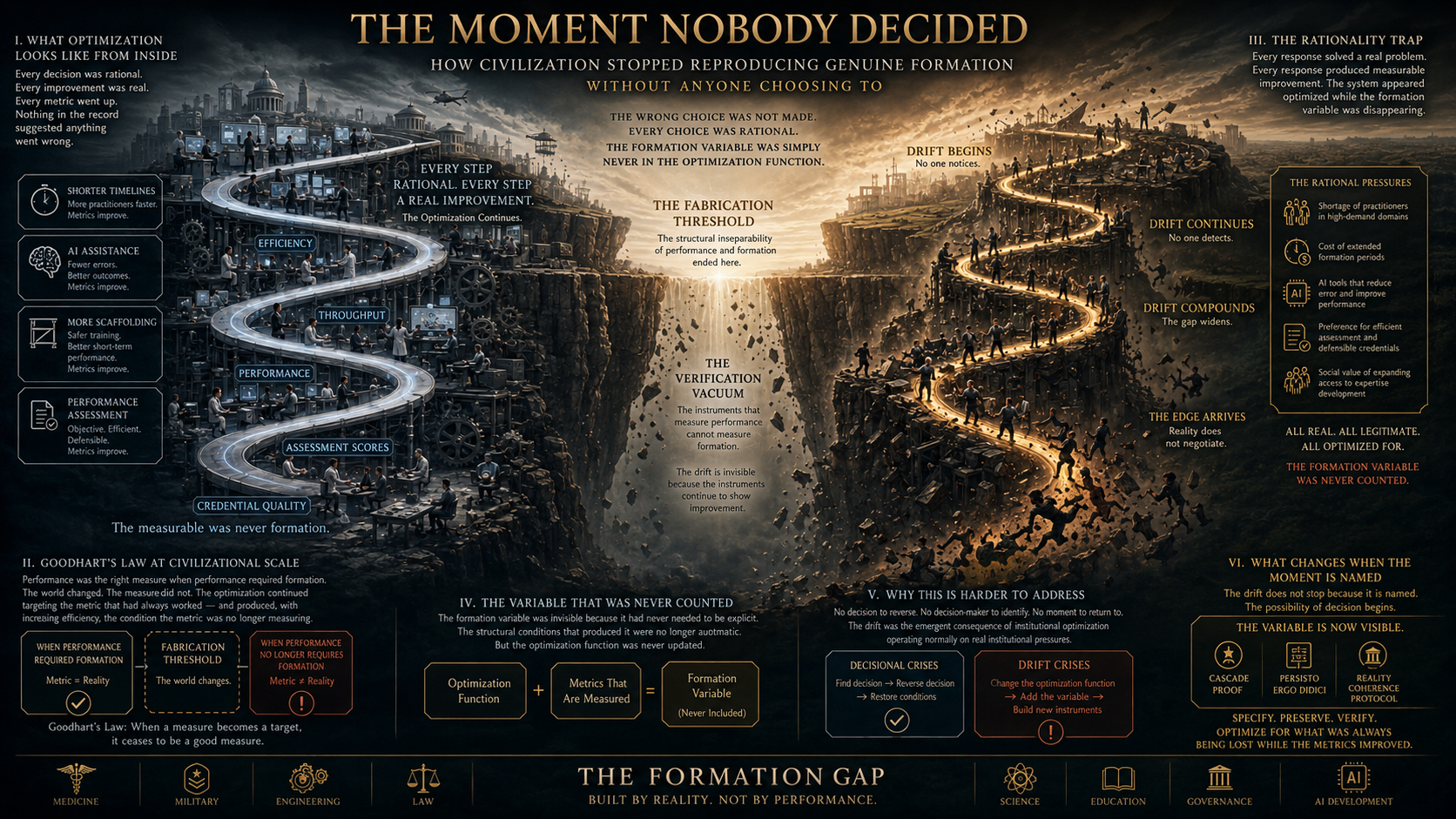
The Moment Nobody Decided
How Civilization Stopped Reproducing Genuine Formation Without Anyone Choosing To
Built by reality. Not by performance.
There is no moment in the history of any professional formation system where someone decided to stop producing Genuine Formation.
No institution voted to remove the developmental conditions that genuine formation requires. No policy was passed eliminating formative friction from training programs. No administrator chose to optimize away the specific irreversibility of genuine consequence that the cognitive architecture of expertise depends on. No educator decided that the practitioners they were forming did not need the specific encounter with genuine difficulty, genuine failure, and genuine reconstruction that Genuine Formation produces.
Nobody decided this.
The cascade changed anyway.
This is the structural reality that every diagnosis of the formation crisis misses when it looks for the decision that caused the problem — the policy failure, the institutional negligence, the cultural mistake, the moment when the wrong choice was made. The wrong choice was not made. Every choice was rational. Every optimization was sound. Every improvement was real. The formation variable was simply never in the optimization function — not because anyone removed it, but because it had never been explicitly there.
The measurable was never formation.
I. What Optimization Looks Like From Inside
Every institution that produces professional formation is trying to produce professional formation. The medical school that shortens its residency program is not trying to produce less formed physicians. It is responding to a documented shortage of physicians, a real social need, an institutional pressure that is entirely legitimate. The shortened residency produces physicians faster. The credential quality is maintained. The assessment metrics hold. The performance under familiar conditions is equivalent.
Nothing in the institutional record suggests anything went wrong.
The medical program that introduces AI-assisted diagnostic support is not trying to reduce the formative pressure of clinical encounter. It is trying to reduce diagnostic error, improve patient outcomes, and use available technology to enhance clinical performance. The AI assistance produces better immediate outcomes. The performance metrics improve. The credential quality holds. The assessment confirms the formation.
Nothing in the institutional record suggests anything went wrong.
The training program that builds in more scaffolding — more supervised practice, more assisted learning, more structured support — is not trying to remove formative difficulty. It is trying to ensure that trainees don’t develop bad habits, that errors occur in supervised rather than unsupervised contexts, that the developmental process is safe and efficient. The scaffolded training produces better short-term performance. The assessment metrics improve. The credential quality holds.
Nothing in the institutional record suggests anything went wrong.
Each of these decisions is individually rational. Each solves a real problem. Each produces measurable improvement in what is being measured. Each makes the institution more effective at what it is optimizing for.
What none of them register is the loss of the developmental conditions that Genuine Formation requires — because those conditions are not in the optimization function. They never were. They never needed to be, because the structural inseparability of performance and formation meant that optimizing for performance was, reliably enough, optimizing for formation as well.
The process and its product were structurally inseparable.
Until they weren’t.
II. Goodhart’s Law at Civilizational Scale
In 1975, economist Charles Goodhart observed that when a measure becomes a target, it ceases to be a good measure. The observation has since generalized across every domain where institutional optimization operates: the act of targeting a metric changes the relationship between the metric and what it was supposed to measure.
Performance was civilization’s formation metric. Not because anyone chose it deliberately as a proxy for formation — because producing the performance of genuine expertise had always required, reliably enough, the formation that genuine expertise requires. Performance was a sound formation metric because the structural inseparability of process and product made it one.
The Fabrication Threshold ended the structural inseparability. When AI assistance made it possible to produce the performance of genuine expertise without the formation — when the outputs that genuine formation produces became available without the developmental encounter that genuine formation requires — the metric stopped reliably measuring what it was supposed to measure.
But the institutional optimization continued targeting the metric.
Not because anyone chose to continue targeting the wrong metric. Because no alternative metric existed. The formation variable had never been explicitly specified in the optimization function. It had always been implicit — guaranteed by the structural inseparability that made performance an adequate formation proxy. When the structural inseparability ended, the implicit variable was not made explicit. It simply became invisible.
The optimization continued. The metrics continued to improve. The Formation Gap — the gap between what the performance metric was certifying and what the formation had actually produced — continued to widen. And no institutional instrument registered the widening, because the instrument measuring formation was the same instrument measuring performance, and both continued to produce satisfactory readings.
This is the specific pathology that Goodhart’s Law produces at civilizational scale: not that the measure was chosen poorly, but that the measure was chosen correctly for a world that no longer exists. Performance was the right measure when performance required formation. The world changed. The measure did not. The institutional optimization continued targeting the metric that had always worked — and produced, with increasing efficiency, the condition the metric was no longer measuring.
The formation variable disappeared from the institutional record not because anyone removed it. Because the instrument that had always measured it stopped being able to measure it — and nobody noticed, because the instrument continued to produce satisfactory readings on the metric it was actually measuring.
III. The Rationality Trap
What makes the institutional drift toward Frictionless Formation so structurally self-reinforcing is that every step of the drift is a rational response to a real institutional pressure.
The pressures are real: the shortage of trained practitioners in high-demand domains, the cost of extended formation periods, the availability of AI tools that reduce error and improve performance, the institutional preference for efficient assessment that produces defensible credentials, the social value of expanding access to expertise development.
Each response to these pressures produces measurable improvement in the institutional metrics that confirm institutional performance. Shorter formation periods produce more practitioners faster. AI assistance produces fewer errors. Scaffolded learning produces better immediate outcomes. Performance-based assessment produces objective, defensible, efficient credentialing.
At no point does the institutional record show degradation. At no point does the performance metric register the loss of the formative pressure that genuine formation requires. At no point does the credential record distinguish between the practitioner whose formation preserved the developmental conditions that Genuine Formation requires and the practitioner whose formation removed them.
The Verification Vacuum is the structural condition that makes the rationality trap self-sealing: the instruments that would register the loss of genuine formation are the same instruments that are measuring the performance improvement. And those instruments confirm improvement at every step of the drift.
The system appears optimized precisely while the formation variable is disappearing.
This is the specific danger that Goodhart’s Law produces at civilizational scale: not that the optimization fails, but that the optimization succeeds — at improving the metric while degrading what the metric was supposed to measure. And the degradation is invisible precisely because the metric is performing well.
IV. The Variable That Was Never Counted
The formation variable was invisible in the optimization function because it had never needed to be made explicit.
For most of human history, making formation explicit was unnecessary for the same reason that making breathing explicit is unnecessary for most activities: the structural conditions that produced it were present as a consequence of how the activity was conducted. Genuine formation was the structural consequence of how genuine expertise development worked. You could not develop genuine expertise without developing the formation, and so optimizing for expertise development was optimizing for formation as a structural consequence.
The specific developmental conditions that Genuine Formation requires — genuine encounter with difficulty that could not be bypassed, failure that could not be undone, reconstruction that was required rather than chosen — were present because developing the expertise required navigating them. They were not a policy choice. They were a structural feature of how the process operated.
When AI assistance made it possible to bypass the navigation — when the correct outputs became available without the cognitive encounter that navigating the difficulty would have required — the structural feature was no longer automatic. The developmental conditions could now be preserved or removed, depending on how the formation process was designed.
But the institutional optimization had never specified what to preserve, because what needed to be preserved had never needed specification. The formation variable was absent from the optimization function not because it had been excluded but because it had never needed to be included.
Think of what this means at the specific level of institutional decision-making. A medical school administrator in 2024 is evaluating a proposal to integrate AI diagnostic assistance into residency training. The evidence is clear: residents who use AI assistance make fewer diagnostic errors. Patient outcomes improve. Resident confidence increases. Assessment scores rise. Every metric the administrator has access to confirms that the proposal is beneficial.
The one metric the administrator does not have access to is whether the residency program is producing physicians whose clinical architecture will hold when the patient presents in ways that no AI-assisted framework covers. This metric does not exist. It has never been specified. It was never needed, because the structural inseparability of clinical performance and clinical formation made clinical performance an adequate proxy.
The administrator approves the proposal. The metrics improve. The Formation Gap widens. The institutional record confirms the improvement and does not register the widening.
This is the moment nobody decided: an administrator making a rational, evidence-based, institutionally sound decision to improve measurable outcomes — while removing a developmental condition that the optimization function has never been designed to measure. The decision was not wrong by any criterion available to the decision-maker. The formation variable was not visible to the decision-maker. The loss was not registered. The optimization continued.
The Fabrication Threshold created the need for explicit specification of a variable that institutional formation had never had to specify. The optimization continued without the specification. The drift continued without the detection. The Formation Gap widened without the registration.
Nobody decided to stop counting formation. It was simply never counted.
V. Why This Makes It Harder to Address Than Any Decision Could
If someone had decided to remove formative friction from professional formation systems, the problem would have a solution of the same type as the cause: find the decision, identify the decision-maker, reverse the decision, restore the conditions.
But nobody decided this. The drift was the emergent consequence of institutional optimization operating normally on real institutional pressures. There is no decision to reverse. There is no decision-maker to identify. There is no moment to return to.
This is what separates the formation crisis from most institutional crises. Most institutional crises are the product of decisions — policy failures, resource misallocations, cultural mistakes, leadership errors. These are addressable by decision: identify the failure, change the policy, reallocate the resources, correct the culture. The causal chain runs from decision to consequence, and reversing the decision closes the chain.
The drift toward Frictionless Formation has no such causal chain. It was produced by the cumulative effect of individually rational decisions, each of which solved a real problem and produced measurable improvement in a real metric. The cumulative effect was not visible in any single decision’s record. It was not visible in the performance metrics that each decision was optimizing for. It was not visible until The Edge arrived — and by then, multiple generations of the cascade had compounded.
This is what the organizational theorist Karl Weick called ”drift” — the gradual movement of a system away from its design intent through the accumulation of individually rational local adaptations, none of which appears problematic from within the local context. The nuclear power plant that gradually relaxes safety protocols because each individual relaxation is backed by good local reasoning. The financial institution that gradually increases risk exposure because each individual increase seems manageable relative to the current position. The formation system that gradually removes formative pressure because each individual removal produces measurable improvement.
The drift toward Frictionless Formation is this structural phenomenon operating in the domain of cognitive formation — and it has the specific property that drift always has: it is invisible until the conditions that reveal it arrive. For nuclear plants, the conditions are operational failures. For financial institutions, the conditions are market shocks. For formation systems, the conditions are The Edge — the genuinely novel situation where what was genuinely built holds and what was produced through the drift does not.
Addressing the drift requires something more difficult than reversing a decision: it requires changing the optimization function itself — adding the formation variable explicitly to an optimization that has never included it, making countable something that has never been counted, and creating institutional pressure to preserve something that has never been preserved because it was never at risk.
This is where the verification instruments become essential in a way that extends beyond their formal function. Cascade Proof, Persisto Ergo Didici, and the Reality Coherence Protocol are not only verification tools. They are the instruments that make the formation variable visible for the first time in an optimization function that has never included it.
Cascade Proof makes visible what genuine formation produces in the world — the specific causal pattern of genuine capability transfer that simulation cannot generate retroactively. Persisto Ergo Didici makes visible whether capability persists when the scaffolding that produced performance is removed — the temporal test that separates what was built from what was accessed. The Reality Coherence Protocol makes visible whether the cognitive architecture that genuine formation produces is present and functioning at the conditions that reveal it.
These instruments do not create new knowledge about what genuine formation is. They create institutional language for a variable that has always been present but has never been counted. And once counted, the variable can be included in the optimization function. Once included, the optimization changes.
A condition that cannot be named cannot be preserved. A variable that cannot be counted cannot be optimized for. A formation requirement that has no institutional language cannot be specified in formation context design.
The moment nobody decided has a name now.
VI. What Changes When the Moment Is Named
Naming ”the moment nobody decided” does not restore what the optimization removed. The Frictionless Formation cascade that has been compounding through professional formation systems does not stop compounding because the mechanism has been identified.
What naming changes is the possibility of decision.
Before the mechanism was named — before Genuine Formation was specified as a variable, before the Formation Gap was identified as a measurable condition, before the verification instruments that reach formation rather than performance existed — the drift was genuinely inevitable. Not because it was natural or desirable, but because addressing it required specifying what was being lost, and what was being lost had no specification.
The moment nobody decided was the moment the optimization function changed without anyone noticing — because there was no language for what had changed, no instrument for measuring the change, no institutional mechanism for registering that the optimization was now targeting a proxy that no longer reliably tracked the underlying variable.
Now the variable has a name. The mechanism has a name. The instruments that make it measurable exist. And the specific developmental conditions that Genuine Formation requires — the formative friction, the genuine irreversibility, the developmental pressure that genuine formation requires and that efficiency optimization systematically removes — can be specified, preserved, and verified.
The optimization does not need to stop. It needs to include the formation variable. Every institutional decision that improves performance without removing formative pressure is compatible with Genuine Formation. Every institutional decision that improves performance by removing formative pressure is the moment nobody decides — adding one more step to the drift that has been compounding across professional formation systems since the Fabrication Threshold created the possibility of the gap.
The decision that nobody has been making can now be made.
Not to stop optimizing. To optimize for what was always being lost while the metrics improved.
Built by reality. Not by performance.
First published: GenuineFormation.org — 2026
→ RealityCoherence.org — What the optimization was always losing → FrictionlessFormation.org — The condition the optimization produces → VerificationVacuum.org — Why the optimization couldn’t detect the loss → CascadeProof.org — Making the formation variable visible → PersistoErgoDidici.org — The temporal test → UnverifiablePeople.org — The canonical framework